Sunday, April 8, 2012

Saturday, March 17, 2012
Reality TV: Medium for Empowerment and Social Change?

But do we generally consider reality television to be more than lightweight, time-filling and slightly voyeuristic ways to entertain ourselves by looking into the private spaces of other peoples' lives or to participate in an interactive television game show that allows each of us, if we choose, to help vote someone off the island? Reality TV has had a tremendous impact upon the economics, style, and aesthetics of American television since Survivor and Big Brother hit American television screens in the summer of 2000 as adaptations of successful European programming formulas. Since that time, the reality formats--and the cloning phenomenon--have spread to most corners of the globe, with some local adaptations, as part of the globalization of Euro-American popular culture.
However, few Americans would speculate that the television genres associated with reality TV have the potential to effect any serious social or political change. A news story this week on CNN, "Reality shows revolutionize Arab TV," by Ashley Fantz, intrigues me as it suggests a more political, democratizing--and ultimately peacemaking--agenda for reality shows in regions filled with cultural conflict or under authoritarian regimes. Fantz writes:
The MTV show ["The Real World"], which debuted in 1992, was considered a groundbreaking social experiment. Its creators bet that if young people from vastly different backgrounds lived together, they would eventually -- through fits and fights and hugs -- find common ground. And by watching, the show's audience might, too.
While reality programming now dominates Western entertainment, "The Real World" remains a pioneering blueprint for a burgeoning reality show market in the Middle East and North Africa. Thanks to the region's proliferation of satellite television and its embrace of social media, more and more reality shows are appearing on air.Fantz continues:
The Arab Idol judges, from left, Hassan El Shafei, Ragheb Alama and Ahlam.

Some shows, like "Arab Idol," are imitations of Western franchises. Other productions are unique to Arab culture. "Million's Poet," for example, is a kind of "Def Poetry Jam" meets "Who Wants to Be a Millionaire?" where young people compete for cash to see who is the most talented poet performing traditional Arabic verse. In its first season, the show reportedly got higher ratings than the United Arab Emirates' national sport, soccer.
"Reality shows in the Arab world are a very big deal because they're showing real people are worthy of star attention that maybe only a political or religious leader might get," said Joe Khalil, a visiting assistant professor of communication at Northwestern University in Qatar. "Reality has nothing to do with a state-controlled message."
Khalil says the reality show audience is the same demographic represented in the Arab Spring uprisings.
"This is a demographic that has long been ignored, and reality show producers want that market," he said. "The shows are trying to say to this young and vibrant group who wants to learn, wants to be entertained: 'This is you. This is your culture. These are your values and your decisions. Make them count.' "
***
This led me to explore the possibilities a bit further. In doing so, I came across an article, "Next Generation Peacebuilding and Social Change in the Arab World," on the U.S. Institute of Peace website, focusing upon a 2012 Iraqi reality television series "for young Iraqi peacebuilders" entitled Salam Shabab with the motto, "We are Iraq. We are all Iraq." (Episodes may be seen online, with English and Arabic subtitles.)
Social media are also powerful channels for community-building around the show: Salamshabab.com is a social networking forum that encourages Iraqi youth to express themselves freely, while the series also has a presence on Facebook, Twitter, YouTube and Flickr. Of this program, Fantz writes:
Translated as "Peace Youth," the reality series is filmed in Kurdistan and stars teenagers from across Iraq, many from families who belong to warring sects. The show requires that boys and girls work together on competing teams to tackle increasingly harder physical and academic challenges. Winners get trophies and video cameras, and they become "Peace Ambassadors" with a chance to speak and meet with Iraqi parliament members.
Created by Iraqis with financial backing from Americans, the show debuted in 2010.
A section of the Wikipedia entry on Reality TV entitled "Political Impact" presents additional evidence that reality television may be carrying much more gravitas in its role as an instrument of social transformation in many countries:
Reality television's global success has been, in the eyes of some analysts, an important political phenomenon. In some authoritarian countries, reality television voting has been the first time many citizens have voted in any free and fair wide-scale elections. In addition, the frankness of the settings on some reality shows present situations that are often taboo in certain orthodox cultures, like Star Academy Arab World, which began airing in 2003, and which shows male and female contestants living together. In 2004, journalist Matt Labash, noting both of these issues, wrote that "the best hope of little Americas developing in the Middle East could be Arab-produced reality TV."
In China, after the finale of the 2005 season of Super Girl (the local version of Pop Idol) drew an audience of around 400 million people, and 8 million text message votes, the state-run English-language newspaper Beijing Today ran the front-page headline "Is Super Girl a Force for Democracy?" The Chinese government criticized the show, citing both its democratic nature and its excessive vulgarity, or "worldliness", and in 2006 banned it outright. Other attempts at introducing reality television have proved to be similarly controversial. A Pan-Arab version of Big Brother was cancelled in 2004 after less than two weeks on the air after a public outcry and street protests.
Hissa Hilal on Million's Poet, 2010.
In 2007, Abu Dhabi TV begain airing Million's Poet, a show featuring Pop Idol-style voting and elimination, but for the writing and oration of Arabic poetry. The show became popular in Arab countries, with around 18 million viewers, partly because, according to analysts such as University of Pennsylvania professor Marwan Kraidy, it was able to combine the excitement of reality television with a traditional, culturally relevant topic. In April 2010, however, the show also become a subject of political controversy, when Hissa Hilal, a 43-year-old female Saudi competitor, read out a poem criticizing her country's Muslim clerics. Hilal received the highest scores from the judges throughout the competition, and came in third place overall.

(for citations for this Wikipedia quotation, see below)
Bamyan Media is a not-for-profit media organization founded in 2009 by American Anna Elliot, a graduate of Hampshire College, after having first facilitated post-conflict reconciliation workshops in Afghanistan, produced a radio drama with Haitian youth, an ethnography on funeral cooperatives in Haiti, a radio documentary on soldiers in Burma, and a public awareness campaign for indigenous women on US reservations. Bamyan proclaims its mission: "Through producing locally relevant popular television programs, Bamyan Media inspires marginalized people in the developing world to lead change and create prosperity in their communities by building social enterprises."
In addressing why Bamyan has chosen the reality television program as the medium for effecting social change, the Bamyan website explains:
For further reading on the issues raised in the Wikipedia quotation above, please see:
Almost every country has its version of a pop idol contest — what if social entrepreneurs became the popular heroes of a new generation? Television is still the world’s most consumed medium. The reality TV genre has proliferated because it is popular with viewers and inexpensive to produce, giving it a vast reach — and making it a cost-effective way to reach millions of people with socially-responsible, empowering programming.
We believe that the reality TV genre offers a powerful platform for “edutainment.” It is also inexpensive to produce and has a vast reach, in addition to a compelling, untapped potential for high-impact dissemination of knowledge and resources. Our work will be to harnesses the power of mass media specifically television, YouTube, Facebook and Twitter to inspire a new generation of youth leaders and accelerate the spread of social innovation through reality TV.
Our programming also serves as a platform for social change — with its selection of contestants and the development of episode topics and series plot, Bamyan Media works to promote cultural diversity, the status of women and minority groups, and healthy consumption and environmental practices. Bamyan believes in the power of popular media to influence behaviors and positively reflect society back onto itself.Exploring the impact of various types of participatory media (including both broadcast media and social media) on different cultures, and especially the adaptation of what seem innocuous program vehicles in one culture to vehicles of empowerment (with life-changing consequences) in another, are worthy areas of study and future research.
For further reading on the issues raised in the Wikipedia quotation above, please see:
- Lynch, Marc (2006). "'Reality is Not Enough': The Politics of Arab Reality TV".
- Labash, Matt (October 18, 2004). "When a Kiss Is Not Just a Kiss". The Weekly Standard.
- "Democracy Idol". The Economist. September 8, 2005.
- Macartney, Jane (August 29, 2005). "TV talent contest 'too democratic' for China's censors". The Times (London).
- "Footage from banned Chinese "Pop Idol" receives Cambridge premiere"(Press release). University of Cambridge. July 5, 2007. Retrieved July 29, 2007.
- "Arab Big Brother show suspended". BBC News. March 1, 2004.
- Winner's tribe put the millions in Million’s Poet, James Calderwood, The National, April 19, 2010
- Move over American Idol: Hissa Hilal in finals of Arab reality TV poetry contest, Kristen Chick, Christian Science Monitor, April 7, 2010
- Hassan, Hassan (March 19, 2010). "Million's Poet finalist defies death threats". The National
Tuesday, February 21, 2012
Images as Witness: Photography, War and Peace
my testimony. The events I have recorded should
not be forgotten and must not be repeated."
-James Nachtwey-
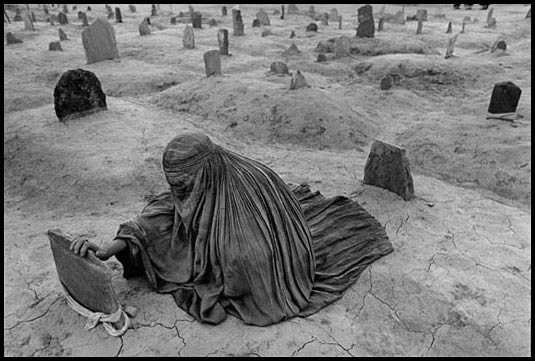 |
| James Nachtwey, Afghanistan, 1996. Woman mourning a brother killed by a Taliban rocket. |
Recently, on February 11, 2012, American war photographer James Nachtwey received the third Dresden International Peace Prize in Dresden, Germany--a leading city of European art and culture that was nearly completely destroyed on February 13, 1945, by Allied bombing. The prize was awarded and lauded by renowned German filmmaker Wim Wenders, who in his remarks said,
...It is the nature of war to engage and take in everything, to occupy and appropriate, without exception. Which war film, for example, isn’t, deep down, a glorification of war, even against better judgment, and often even in spite of the best intentions?
And: It is in the very nature of images to represent what they depict. “What you see is what you get.” That’s exactly what makes them so very powerful. It’s almost like trying to square the circle if you want to dissociate yourself from what an image presents and conveys, let alone try and tell the opposite of what it shows.
 |
Wenders continued:
War is a huge, infernal industry, the largest one on this planet. It seems presumptuous for one man to attempt to stand in the way of this machinery. Once war has broken out, everything spirals out of control almost immediately, turning even the armies and the soldiers who fight in it into helpless onlookers, victims of their own hubris.
Who would dare then to oppose it and put it into perspective with mere… photographs. Who would seriously deploy cameras against tanks? Just make the effort and visualize it for yourself!
 |
| James Nachtwey, 2007. Photograph by Jaap Arriens, from Wikimedia Commons. |
After all, almost all of us take pictures today. Even your cell phones don’t come without a camera any more. Or perhaps you have one of those small, convenient digital devices. Or you may even own some professional equipment… Just imagine going to war with that! And imagine doing so just to take a picture to undeceive the entire world and tell them what’s going on there.
Yes: a photo that would influence the outcome of the war or even end it! Right. That would be sheer madness!
All right then, imagine just this: You want to change the life of ONE person with a photograph. That alone is an enormous challenge, if you think about it.
The short moment when you look through the viewfinder or at the tiny display, as you point the camera at something, and finally press the shutter button… that second is supposed to achieve something, to capture something and thus captivate, and thereby move somebody, or more so: even shake up the world?
How can that be possible? Who do you have to be to attempt such a thing? How… would you possibly go about it?
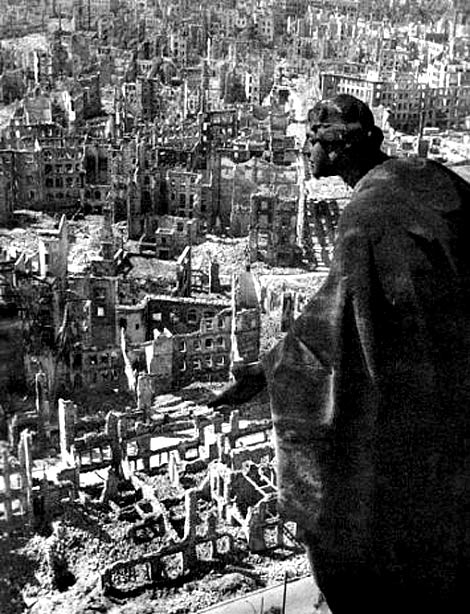 |
| Dresden, 1945 |
 |
| Dresden, 1945 |
 |
| Dresden, 1945. At least 25,000 people were killed in a single day during the Allied bombings. |
A Dresden press release reports:
In explaining the decision to award the Dresden Prize to James Nachtwey, Nobel Prize winner Guenter Blobel, President of the Friends of Dresden in New York and vice chairman of the Friends of Dresden Deutschland:
The prevention of violence is especially effective when a picture is conveyed of that which the violence of war is.
James Nachtwey is one of those who, without consideration of the danger to him- or herself, bring such pictures to us, pictures which we can never forget. And he does this as a moralist, as one who doesn’t merely hope, but rather believes that his pictures can change the way we think.
Without the photographs of Dresden in ruins, its destruction would have been long erased from the world’s memory and no longer a warning against armed conflict.
Through the photographs of James Nachtwey other wars remain in our thoughts.
Susan Sontag wrote: "Wars of which there are no pictures are forgotten."
And forgetting wars must not happen because then we forget their victims as well.
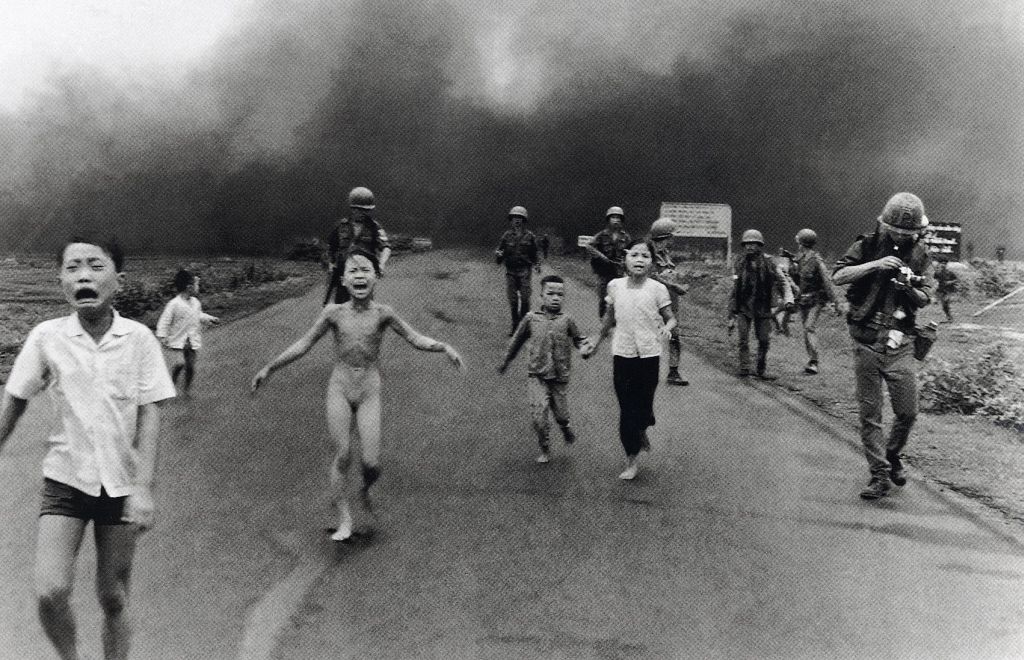 |
| Nick Ut (Huynh Cong Ut), Villagers fleeing napalm attack on Trang Bang village, South Vietnam, June 8, 1972. From http://leicaphilia.com/wp-content/uploads/2014/04/Nick-Ut-Children-Fleeing-an-Aerican-Napalm-Strike-1972.jpg. |
Photojournalists and documentary filmmakers who cover war and victims of injustice put themselves in danger's path every day to try to find and capture those images that might imprint themselves upon our collective conscience--that might make each of us stop, for a moment, from our busy lives and not only ponder the philosophical questions of morality and human responsibility but also, perhaps, to take some action.
What is it about an image, or a film, that can sear itself into our brains and continue to haunt us for the rest of our lives?
 |
| Jeff Widener, Tienanmen Square, Beijing, China, June 5, 1989 |
How can we be moved to not only think to ourselves, "Never again," but to do whatever is in our power to champion nonviolence and promote peace?
How can a "mere" image change a life? What is the power of the visual image? What is the power of art, in general, to move our hearts, to touch our souls, to motivate us to speak and act in new ways?
Subscribe to:
Posts (Atom)