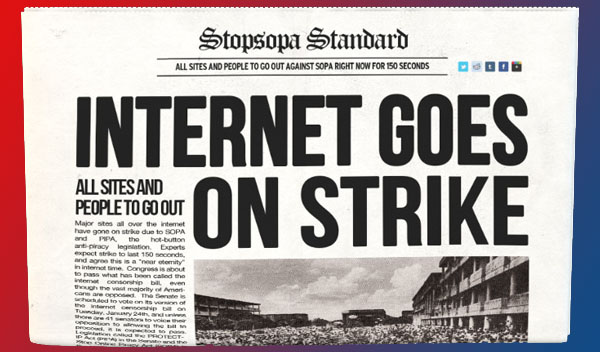
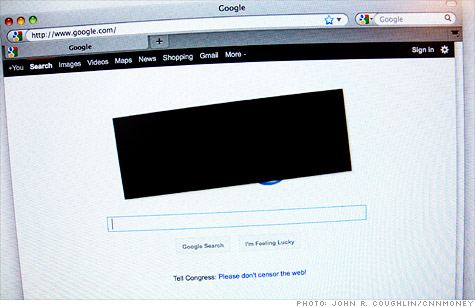
Today we are witnessing a momentous cyber-protest: the intentional self-blackout of dozens of popular U.S.-based websites and technology blogs to protest, and call public attention to, two bills currently in the U.S. Congres aimed to regulate the internet. These bills are the Stop Online Piracy Act (SOPA) in the House of Representatives and the Protect Intellectual Property Act (PIPA) in the Senate. Many in the civil society of the internet believe that, in their current form, H.R. 3261 and S.968 represent what Salon writer Andrew Leonard calls "a stark, existential threat to the core architecture of the free and open Internet."
According to Washington Post writer David Farenthold, "The idea is to cut off the channels that deliver American customers, and their money, to potential pirates. But tech companies see the laws as a dangerous overreach, objecting because, they say, the laws would add burdensome costs and new rules that would destroy the freewheeling soul of the Internet."
Major and popular web-based presence Wikipedia (a collaborative, nonprofit organization for amassing knowledge), Google's search engine (the mother of all search engines in America), blog builder site WordPress, social news site Reddit, internet classified site Craigslist, and prime technology sites Wired, Techcrunch, Mashable, Mozilla, among many others, turned off their content today to join the protest.
Will the protest cause Congressional leaders to sit up and take notice? Watch and see. Our media future will be affected by the outcome of this movement.
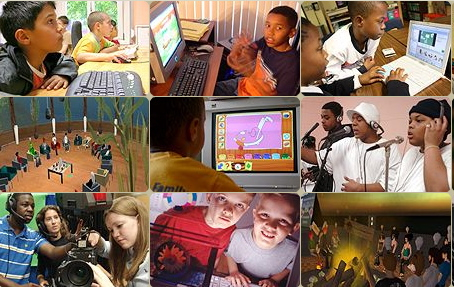
Last spring, I initiated a new course at Reinhardt University, a freshman-level COM 103: Media Literacies for the 21st Century, which fulfills the composition requirement. This spring, we are back for the new season, with an enthusiastic group of students with diverse backgrounds, a slightly revamped syllabus and reading list, and a lot of eager anticipation on my part about what we will discover on this new journey together.
While the first class session was spent going over logistics of the syllabus, we had a fabulous and engaging class discussion during our second session after reading Henry Jenkins' Eight Traits of the New Media Landscape and Mark Prensky's Should a 4-year-old have an iPhone?. Jenkins' blog entry (from November 2006) discusses how the contemporary media landscape is:
1. Innovative
2. Convergent
3. Everyday
4. Appropriative
5. Networked
6. Global
7. Generational
8. Unequal
Prensky's brief personal musing about the appropriateness of new technologies for young children fed into our class discussion as well, especially since a number of the class members were parents of young children themselves or had younger siblings and frequently compared their own experiences "growing up digital" with those of the youngest generation.
Today's class will be a collaborative attempt to define what media literacy is--and how the concept of literacy has necessarily changed and continues to change. Class members will share their own blog entries on this topic. I'll share here a power point I created on what I see as the most important reasons for a course like this:
Increasingly in today’s world, the media we use to receive and create messages are forms of digital, computerized communication. This includes communication via the internet, mobile phones (including text messaging), instant messaging, and digital still and video imaging devices.
Some of the functions of this kind of communication are:
CREATING AND MAINTAINING SOCIAL BONDS. Some of the most significant uses of this kind of communication are through “social media” sites such as Facebook, where we share a great deal of personal information. These may also include relationship-building sites such as online dating.
SEEKING NEWS AND INFORMATION. Many of us also use the internet to receive much of our news of the world through news sites (journalism), either text- or video-based. We also use the internet to do research online, either through Google searches or through academic databases.
ENGAGING IN COMMERCE. Many people shop online, completing transactions without ever physically entering a store. Others use digital media as platforms from which to market and sell their products.
ARTISTIC EXPRESSION. The internet has become an important outlet for artistic media, ranging from the work of independent artists who can distribute their work directly to their audience without having to go through corporate distributors (such as record companies).
ENTERTAINMENT. Television and films can now be viewed at your convenience through your digital devices rather than in the more traditional media channels, and new forms of entertainment made especially for the web (such as webisodes) are also developing.
CREATING AND PARTICIPATING IN COMMUNITIES. Many people have used the web to find other people with shared interests and experiences and to work together to achieve a common purpose. No longer do you have to be in the same place, geographically, to be part of a community. In fact, you can be part of many different online communities depending upon special interests.
SELF-EXPRESSION AND PERSUASION. Blogs have become a prime way for people to share their ideas, beliefs and interests. Websites, and especially blogging, have also become an important form of persuasion in our digital “public sphere” since it is a significant way that individuals and groups try to influence the beliefs and attitudes of others about social and political issues.
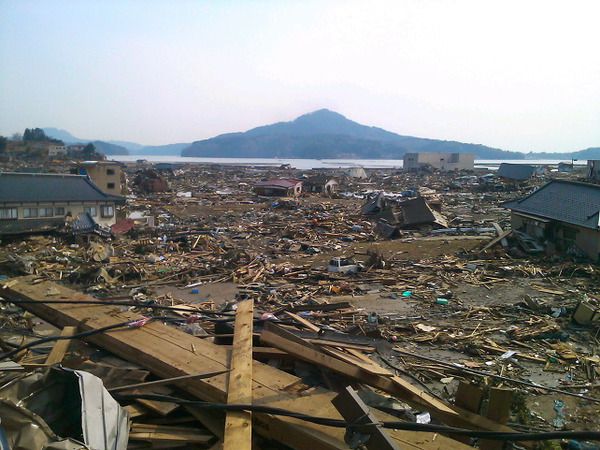
Spring break is over, and I return to my blog. In the past few days, Japan has endured one of the strongest earthquakes in its history, been deluged by a tsunami, and is now threatened with nuclear meltdown. Similarly, the images and news from Japan have riveted us here in America to our screens (whether television or computers) as we've had perhaps the largest-scale media coverage of such a natural disaster in history. Professional journalists and amateur photographers, videographers and bloggers alike have reported their stories and images in the most vivid ways possible.
A recent New York Times article by Jennifer Preston examines some of the concerted efforts to coordinate this first-hand news sharing by an organization called Global Voices, "a volunteer-driven organization and platform that works with bloggers all over the world to translate, aggregate and link to online content." Preston writes:
Soon after the earthquake and tsunami struck Japan on Friday, the volunteer bloggers for Global Voices in East Asia put together special coverage of the devastation, sharing citizen videos and translating posts on Twitter, including calls for help from people stranded on the upper floors of buildings. Over the weekend, with fears fueled by the prospect of a second explosion at a nuclear plant, they monitored the conversation on the social Web, reporting how people were exchanging information to keep safe and questioning the use of nuclear energy in an earthquake-prone region.
“Our job is to curate the conversation that is happening all over the Internet with people who really understand what is going on,” said Rebecca MacKinnon, a former Tokyo bureau chief for CNN who founded Global Voices with Ethan Zuckerman, a technologist and Africa expert, while they were fellows at Harvard’s Berkman Center for Internet and Society. “We amplify, contextualize and translate what these conversations are and why they are relevant.”
In this era of new spreadable media, sometimes good things happen as a result. Michael Martinez of CNN reports on a Japanese student in California who discovered that her family, who lived in one of the communities hardest-hit by the tsunami, was safe--by seeing their message in a YouTube video.
The past few days, sitting at home and in my office in New York, it felt like I had more information and contacts at my fingertips than I did then as a reporter in Japan. The morning I learned of the quake, I had a TV connected to digital cable, an iPad, a Blackberry and a web-connected computer in my living room.
I flipped among ABC, NBC, MSNBC, Fox, CNN, and BBC on TV. An iPad app gave me video of quake alerts in English and other languages from Japanese national broadcaster NHK. I dipped into the Twitter and Facebook streams.
A photo slideshow on the front page of the New York Times only a few hours after the quake gave a sense of not just the depth of destruction but also the geographic breadth. The towns being mentioned in captions spanned multiple prefectures (similar to states).
I was able to watch Japanese TV network TBS live via a Ustream link I was referred to in a "Japan Quake" page assembled by my New York-based friend and media colleague Sree Sreenivasan.
Benkoil continued,
Some connections were possible this time only because of technology. I was able to observe New Jersey-based relatives of my Tokyo-based translator friend express love and relief that she and her family in Japan were safe. My friends in the U.S. and elsewhere used Facebook, Twitter and text messages to ask me about my loved ones in Japan, which let me reply in a way that was much easier to handle than in the previous era.
The media and communication technology of course do not change the scope of the disaster but do change the way we are able to experience and share it.
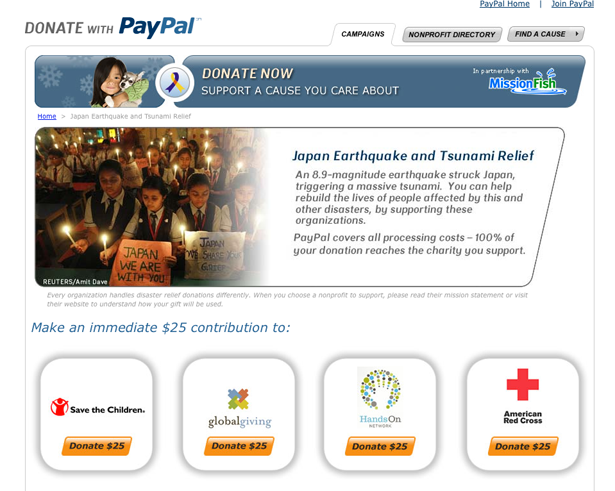
Perhaps most importantly, social media have become a primary channel for raising awareness and gathering funds for relief efforts. An article by Matt Wilson of Ragan.com provided an early summary of where to go if you would like to help, discussing how Twitter, Facebook and text messaging are being used to spearhead relief fundraising, and AFP reports that Zynga, the company behind the "FarmVille" game (a Facebook app), raised $1 million within 36 hours for Save the Children's Japan relief efforts:
Zynga asked users to donate money through the purchase of virtual goods in FarmVille, CityVille, FrontierVille and its other games. All of the proceeds from the purchase of sweet potatoes in CityVille, radishes in FarmVille or kobe cows in FrontierVille are going towards Save the Children's relief efforts.
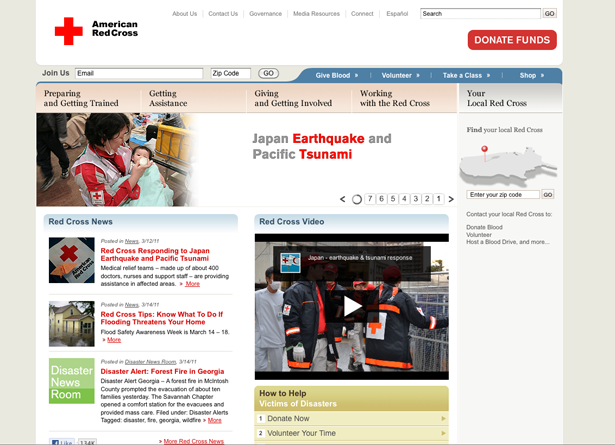
Apple has set up an option on iTunes to allow users to donate from $5 to $200 to the American Red Cross and the Red Cross has launched a campaign on Facebook through the social media giant's Causes function.
The Atlanta Journal-Constitution reports that The Salvation Army and the American Red Cross are also raising funds for the Japanese crisis by accepting $10 donations via text message.
To donate to the Salvation Army, which has had a presence in Japan since 1895, text "Japan" or "Quake" to 80888.
Text "RedCross" to 90999 to donate to its fund set up in response to the disaster. The American Red Cross is coordinating with its Japanese counterpart, which is leading the organization's efforts in the disaster area.